Wilderness
News
Newsletter of Hiking New Zealand - No. 12 - December 2004
In this newsletter
West
Coast Wilderness Hiking Safari
Kia Ora
I’m Terry. Some of you know me, and remember me toting a backpack
twice my size, and (allegedly) eating more than my weight in food. I’m
here to guide you on one of our favourite trips, the ten-day West Coast
Wilderness – from the comfort of your own armchair, we will do it
the painless way, without raising a sweat or getting your feet wet (although
I hasten to add, it’s nothing like the real thing!). So sit back
and enjoy. But first…
New Zealand’s success
story
We’ve kept it a secret for a long time, but now the whole world
seems to know about New Zealand. Lonely Planet’s New Zealand guide
has recently edged out their Australia guide as their best-selling book,
while LP staff have voted New Zealand the “hottest destination in
the world” for the last two years. For the third successive time,
readers of the U.K.’s ‘Wanderlust’ magazine have voted
New Zealand their favourite international destination. That’s not
bad for a little bunch of islands that’s about as far as you can
get from most people on the globe – but then, maybe that’s
its charm.
The good news for us and our clients is that most visitors to New Zealand
congregate in just a small number of high-profile destinations –
leaving almost all of the wide-open spaces for a small number of like-minded
souls like us!
West Coast Wilderness –
starts in Nelson
We start our safari in the city of Nelson, New Zealand’s sunniest
place. Hopefully everyone in the group has already made the most of their
stay in the top of the South Island. There’s plenty to do here in
this popular backpacker destination: good beaches, arts and craft shops
and historical neighbourhoods. It’s just a short drive to Abel Tasman
National Park, New Zealand’s most visited national park –
its beautiful coastal walk is a good warm-up for our exertions on safari,
and the kayaking around its headlands and picturesque islets is some of
the best anywhere (for a guided walk see our Abel
Tasman walk). If it’s the mountains you’re after, head
60 km south to the Nelson Lakes area where some of New Zealand’s
finest tramping awaits (or better still, do it as part of our Eastern
Epic safari!).
Kahurangi National Park
-
We’ve barely left Nelson and the group are already busily chatting
among themselves and I feel bad for breaking in to describe the safari.
Our minibus has a hard start to the trip, up a steep windy road to Flora
Saddle– but she always gets us there and we are already in the wilderness
without having walked a step. This is the start of our first overnight
tramp, and after the group gear is distributed and backpacks are loaded
up, it is the moment of truth. Everyone self-consciously puts on their
fully-laden backpacks and steps out onto the track. There’s a cool
wind and a cloudy sky, but it doesn’t matter because we’re
walking in the shelter of the southern beech forest today. This is the
eastern edge of Kahurangi, New Zealand’s third largest National
Park, which stretches over a multitude of forests, open-topped ranges
and deep gorges westward all the way to the Tasman Sea. But some of the
best of the national park is right here, on our route for the next two
days.
A limestone roof for the
night
A wide seam of limestone runs through this part of Kahurangi National
Park, and the twin actions of geological faulting and running water have
carved out all sorts of interesting forms. Such as the overhangs in the
forest, that have been embellished by some local ingenuity - a wall here,
a platform there, a few bunks over there - to make very adequate and charming
places to stay the night. We peer into a few on the way, and at the end
of the day we make ourselves comfortable under a large one that looks
out on to a tussocky clearing. In the evening we get a fire going, and
when it’s flickering brightly on the rock wall we run through the
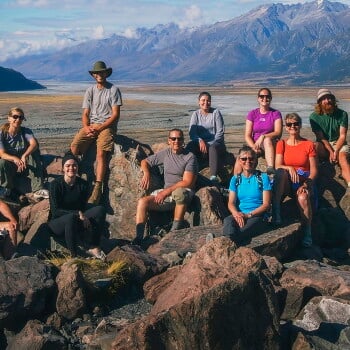
introductions. We have among us psychologists, nurses, journalists, project
managers and a therapeutic masseuse who is already getting bookings to
treat tired limbs. They come from the UK, Germany, Switzerland, the Netherlands,
USA, and there’s even a couple of Aussies who have ventured across
the Tasman Sea to see what real mountains look like.
An
archipelago with strange creatures
But before we go to sleep, a quick natural history lesson. New Zealand
was once a tiny corner of the primaeval megacontinent called Gondwanaland.
About 85 million years ago it sheared away from the bits that became Australia
and Antarctica, and quickly put a lot of space between it and its mother
continent. It’s been alone way out there in the Pacific ever since.
What made New Zealand’s life forms interesting is that it had no
land mammals – so the other animals that were here evolved in strange
ways. In particular, without mammal predators, many birds, reptiles and
insects became big, slow-moving and lost their power of flight. Some of
these animals have gone since humans arrived here, but many remain, and
one or two can be seen here in Kahurangi. Enter the weta…
The Beautiful Weta
They look a little like grasshoppers – which is not surprising,
because they are descended from grasshopper-like ancestors way back in
the Gondwanaland days. But if the grasshopper is a sports car, the weta
is a Sherman tank – big and cumbersome, with a large plated body,
thick spiny legs and very long antennae. Some weta species are among the
biggest insects in the world. We think they are beautiful (really!), most
photogenic, and if you are lucky you will see a weta or two at Kahurangi.
Have a look at the tree trunks after nightfall. Lord of the Rings director,
Peter Jackson, obviously thinks a lots of these creatures too. If you
look closely at the movie’s credits, you will notice that the film
production was courtesy of Weta Workshops.
Mt Arthur
Day 2, the weather forecast is good and we get an early start on a rough
track that twists up through the forest. By mid-morning we have gained
the open tops, scaled Gordon’s Pyramid and we’re already getting
glimpses of distant snow-flecked ridges breaking through the lifting cloud.
The cameras are out and busy panning the horizon in all directions. The
ridge onwards stays high, and leads us to the basins on the north side
of Mt Arthur, a jumble of bluffs and potholes that nature has fashioned
from limestone over thousands of years. The clouds have all gone now,
and we find a big limestone slab to lunch and sun ourselves on. Soon after,
from our high point on the Arthur Ridge, Nelson is a distant blur on the
far side of Tasman Bay, and the good news is that it’s all downhill
back to the bus from here. We’re driving through to Murchison and
staying at Suzy’s quirky little cottage-garden campsite. Everyone
is tired after the long day but there’s no cooking to do tonight.
Nadia’s delicious chickpea curry, salad and fresh home-made bread
makes an appearance, and it’s wolfed down quicker than it deserves!
Something foul at Cape Foulwind
We are driving down the Buller gorge early on day 3, watching forests
and swift side-streams go by. And then the scenery abruptly changes as
we emerge out from the gorge to the Tasman Sea, the South Island’s
wild west coast, and the Australians can look out across the rising swell
in the direction of their homeland 2000 kilometres away. The English maritime
explorer, James Cook, had a frustrating week off this coast, beating against
a persistent north-east wind, and he paid it the compliment by naming
it Cape Foulwind. The name is strangely appropriate - there is something
foul in the air, and it’s wafting up from the seal colony on the
rock platform below us. The seals clearly aren’t put off by each
other’s appalling body odour, and today some of the young bulls
are giving us a display of seal testosterone in action, squabbling over
a patch of prime real estate. These New Zealand fur seals almost completely
disappeared from the New Zealand mainland following Maori hunting and
European sealing, but happily they are now coming back and reclaiming
their former territories around our coasts.
Under the Podocarp forest
We can’t hang around at the seal colony too long because our second
overnight tramp is waiting. In the middle of the day we step out across
pastures into the lowland forest, a forest that I still marvel to find
on the same island as the homogeneous beech forest we walked under on
our first tramp. The gentle coastal climate and high rainfall make for
a diverse forest that looks lush and deceptively subtropical, though even
its biggest admirers would not call this part of the world subtropical.
Towering above all the other trees are the podocarps, a group of southern
hemisphere conifers that, like the wetas, had their antecedents in ancient
Gondwanaland. These are the rimu, the kahikatea, the matai and the totara,
revered by the Maori for their food sources, their wood, and for their
grandeur.
Getting wet in the Fox canyon
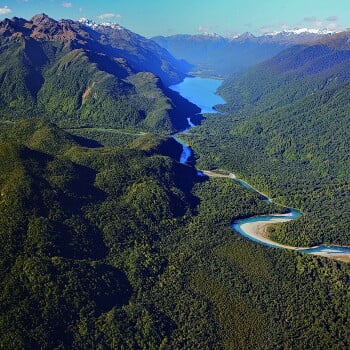
The centrepiece of this tramp is the Fox river system, and we first hit
the water on a remote little tributary that is very pretty but gives no
hint of what is to come. For the first time the cold water seeps into
those nice dry boots, and there’s a chorus of gasps and groans when
it happens. There is no avoiding it – it happens over and over again,
crossing after crossing, as the stream weaves its way through the forest
to its confluence with Dilemma Creek. After the first few crossings, no-one
cares any more about wet boots and the group is soon discovering that
splashing around in streams is great fun, which is just as well as it’s
an essential part of tramping kiwi-style. An important rule is to not
to perch on rocks as you cross – they are often slippery and you
are liable to end up with an unintended full-body soaking. It is far safer
to step into the deeper places between the rocks, where fine stones and
gravels will give you a more reliable footing. Dilemma Creek is a wider,
deeper splash and before we know it, we are enclosed by high limestone
cliffs. A few foolhardy trees cling improbably to the cracks and clefts
on the faces, and the distant silhouettes of many others are like dare-devil
bonsai overhanging the cliff-tops. Just upstream of where Dilemma Creek
flows into the Fox River, we spend the night under the biggest rock overhang
of them all, the Ballroom – appropriately-named because you could
have a jolly big party here, to say nothing of plenty of space for a well-stocked
bar.
There was a bit of drizzle overnight, but the river level is not too high
and we can walk down the Fox River canyon the next day. This is a good-sized
river and where it runs swiftly we link together in groups of four to
get across safely. The deepest crossings are quite safe because they have
have the slowest-moving water, which is good because the group can concentrate
fully on the water level as it comes up to the thighs … the underwear
… the belly-button… Ooohh!
There’s plenty of time at the end of the day to walk around the
famous Pancake Rocks down the road at Punakaiki. A headland of finely
layered limestone has been sculpted by wave action, wind and rain, and
there’s now a strange landscape of towers and pits. The waves surge
in to turbulent pools, and in high seas geysers of water vapour come booming
out of the blowholes.
Water yesterday, ice today
On day six we reach Franz Josef Glacier at midday, and most of the group
are doing the guided glacier walk. We had woken this morning to native
palms in the coastal forest, and here, only three hours driving south,
we find a glacier terminus coming down almost to sea-level. For that we
can thank the heavy snowfalls that stack a whole lot of snow on the glacier
nevé high in the Southern Alps. The huge weight pushes the glacier
downhill at a reckless rate of five metres per year, so that before it
gets a chance to melt it reaches the valley floor of the Waiho River within
a short walk of the rainforest. The local glacier guiding company kits
everyone up with the right gear, and they’re away, way up on to
the glacier, making the most of cut steps on the steep bits, and later
they disappear into the confused workings of an icefall, where they play
around in the slots and grooves, and if they’re lucky there’s
an ice tunnel or two to crawl through.
Kayaking in the lagoon
We are in a little coastal township called Okarito for a couple of nights.
You’re not likely to find Okarito on your world atlas because it
hosts a grand total of 40 people in its idiosyncratic beach houses. In
this little pin-prick of a place there are some interesting characters,
including one of New Zealand’s top landscape photographers and former
Booker Prize-winning author, Kerry Hulme.
On a still misty morning we go kayaking on the lagoon. There’s barely
a sound, the shags are standing on poles drying their outstretched wings,
and framed by the bright mist the black swans are gliding nobly by on
the mirrored surface. We head up a few tidal creeks, leaving the rushes
and flax behind, and find ourselves paddling in narrow channels in a kahikatea
rainforest, in view of a pair of paradise ducks - his head is black, hers
is white. We paddle a bit, then glide in the silence. And when we get
as far up the creek as we can go, the tranquillity is broken - six kayaks
all at once try to turn in a confined space, chaos ensues with much bumping
and splashing, but finally we extricate ourselves, and head out to open
water, disturbing a white heron, one of only 300 in New Zealand, stalking
in the shallows near the shore.
A meal from the hot rocks -
hangi night
The afternoon is a chance for some welcome time off after all the exertions
of the last seven days, and Okarito is definitely a hang-out place. This
is our hangi night – based on a traditional Maori way of cooking,
with a few little modifications. Some of us get digging a large hole in
the sand on the beach, get a good fire going in it and add a few rocks.
When the fire dies down and the rocks are hot, the food goes on top, and
the whole lot is covered by towels and an insulating mound of sand. While
the earth oven quietly incubates, we have a couple of hours to kill. The
weather is now perfectly clear so we take an easy track up to Okarito
Trig. We sit for a while and gaze eastward across the forests to the white
crests of Cook and Tasman, the highest peaks in the Southern Alps.
When we get back, we dig up the hangi, and under the hot, steaming sand
the food is all cooked. It is lifted out and we’re busy cutting
it up and putting it on to plates. We eat, sitting on logs around the
beach bonfire, beers in hand, and as the light fades and the night closes
in, more logs go on the fire and everyone settles in for an evening of
tales about the strange things that go on in Birmingham and Frankfurt,
to say nothing of the truly weird stuff in Los Angeles and Melbourne.
The Copland Track
On day 7 we are tramping up a bush track in the gorge of the Copland River.
It is leading us into the heart of the Southern Alps, sometimes right
by the huge boulders of the river, sometimes high on the forested slopes,
and all day we cross innumerable side streams and landslide debris. The
Southern Alps is a textbook example of what happens when two tectonic
plates collide violently, and one plate is uplifted and bulldozed out
of the earth’s crust. Still, you don’t need to be a tectonic
plate scholar to know that serious things are going on under the ground
here. Or to appreciate the shiny schist rock, that until a few million
years ago was ten kilometres under ground and is now that row of wildly
angled teeth a couple of kilometres above us. Everyone is glad of the
sight of Welcome Flats Hut, a roomy place with a huge bunkroom upstairs.
The thermal pools are only a minute away – it is quite something
to settle in to them, to recline back in the warmth, and to look up at
the cascades, tumbling out of the cloud ceiling down the bare mountain
walls to the forest.
Murder in the mountains
Overnight a downpour lashes the roof, and outside the streams are raging
and for the moment we are cut off from the outside world. By mid-morning
the winds swings from the south, the rain stops and there’s patches
of blue in the sky. The streams are abating as quickly as they rose. We
are here for two nights, and everyone is up for a day walk, so we cross
a swingbridge over the swollen Copland River, and go boulder-hopping up
Scotts Creek. It’s a raw sort of place, where the stream has torn
a broad swathe through the forest, where floods periodically rage down
the wide bed leaving huge schist boulders littered in their wake. Everyone
is enjoying the scrambling. There’s a game of Murder going on and
there’s a pretty ruthless murderer (or is it a murderess?) on the
rampage - from time to we’re confronted with yet another grisly
demise. The stream is still running high and there’s not many crossing
places, but there’s a good spot in the foaming water near the base
of a cascade. We come to an abrupt halt, confronted by a high waterfall
flanked by high bluffs and thick forest. It’s a good place to lunch,
explore a little, and just contemplate the flexing of nature’s muscles.
Whakapohai Beach
Day nine, and we head back down the Copland valley. By mid afternoon we’ve
finished tramping and we’re lounging over lattes at the Paringa
Salmon Farm. Not that we want to get too comfortable, because minutes
later, we are standing with our pale torsos exposed, apprehensively eyeing
the waters of a beautiful forest-girt lake that owes its existence to
ice age glaciations. There’s nothing for it but to charge in, screaming
and splashing. Some might argue that the water is still pretty glacial,
we’re totally refreshed and very much awake when we get back on
board and drive down a dirt road to remote Whakapohai Beach. A light breeze
is keeping the sandflies at bay, so we put up the tents on a sandy spit
above the surf, go for a beach walk and get the fire going. Tonight’s
special is salmon in foil, baked on the embers, and it goes very nicely
with a drop of Monteiths Summer Ale. It’s the last night of the
safari and we sit on the logs around the fire as the sun dips below the
Tasman Sea, and reminisce with our newly-formed friends.
Destination Queenstown
Before leaving the West Coast we stop at our last beach to do some dolphin-spotting.
And we’re in luck, there’s two or three Hectors dolphins cruising
up and down, just beyond the surf. These are inshore dolphins, which means
that they often die in nets, and they’re getting quite rare. It’s
nice to remember that we’re doing our bit for this vulnerable marine
mammal – for every booking on a Hiking New Zealand safari, $10 is
donated to research and conservation of Hector’s dolphin. The West
Coast is now left behind as we drive over Haast Pass, in time for lunch
by Lake Wanaka. It’s time for the clean-up too, but it’s pretty
painless doing it here, with blue waters, steep tawny hillsides and high
crags to greet the eye whenever we look up. By late afternoon, we crest
the Crown Range and Queenstown is there, hugging the shores of Lake Wakatipu
far below us. Soon after, we are in New Zealand’s holiday mecca
and the sight of more people than we’ve seen in the past ten days.
And suddenly it’s all over, not that it’s goodbye just yet
– we catch up in the evening for a meal and the talk is of future
plans. Addresses and emails are swapped, and some are teaming up for more
adventures together. One person even decides on the spur of the moment
to join the Secret South safari, departing in only two days time!
That’s the end of our West
Coast Wilderness safari, but there’s a few more things you may
like to know:
How did I get to be here?
One sunny morning I decided that maintaining computer software was no
longer for me, and the very next day I took the plunge and handed in my
notice. That was all very fine, but when the euphoria of my brave (some
would say reckless) decision had passed, I had to consider the small question
of what I would now do with my life. There were some clues: I love tramping
in the mountains, I am nuts about natural history (I went back to University
and completed a Masters in Botany), and I enjoy sharing what I know with
anyone who wants to hear. So that’s why I am guiding for Hiking
NZ - a ‘rookie’ (a name which makes me sound younger than
I really am), but in this job you learn fast! Every trip has its unexpected
moments – that is just a fact of life when you’re in New Zealand’s
mountains. But I’ve had a lot of pleasure in learning the ropes
in the company of people who bring humour and understanding to all situations.
That, above all, is what will leave me memories to last a lifetime.
Newsletter
Special
To compliment this feature on the West Coast Wilderness we are offering
NZ$100 off the price of this trip (normally $1050). To qualify for the
special you must book direct and answer the question “Name a species
of podocarp tree found in NZ?” It’s easiest to go online to
book - see www.HikingNewZealand.com.
Put the answer to the question in the “Other information”
section. This special cannot be used in conjunction with any other promotion
and bookings must be made before 31st March 2005. While you are on our
website have a look at the other great hiking trips we have to offer.
Previous Newsletters
Wilderness
News 11
Wilderness
News 10