Story of Land | Flora and Fauna |People of Aotearoa |Weather |Wilderness and Tourism |Haka
The
Story of the Land
The landscape of New Zealand is diverse and dramatic. There are steep
mountains, deep lakes, active volcanoes and rugged coasts. The land has
been sculpted by glaciers, rivers, wind, and sea (and bulldozers). These
erosion processes gradually etch their own signatures upon a basic landmass;
a landmass slowly emerging from the ocean as a result of continuous turmoil
deep within the earth's crust.
Flora
and Fauna
Isolated from the evolutionary processes occurring on other continents, New Zealand developed a unique nature
with many of its own plants and animals. The forest floor abounds with animals inherited from Gondwana times -
80 million years ago. Before humans arrived and introduced numerous noxious species, our vulnerable flightless
birds and ancient tuatara were relatively unchallenged. Today, sadly, many of these fragile endemic species are
confined to a handful of pest-free habitats. However, even with the amount of imported produce arriving in the
country, New Zealand still remains free of many potential pests, such as snakes, scorpions and nuclear ships.
People
of Aotearoa
The Maori came to the Land of the Long White Cloud (Aotearoa) from Hawaiki,
land of legend, between 800 and 1200 years ago. The majority lived in
the warmer North Island, establishing a society based on hunting, gathering,
fishing and subsistence agriculture. After European explorers bumped into
the country (Abel Tasman in 1642 and James Cook in 1769), a new wave of
settlers arrived. From sealers and whalers, came traders and profiteers,
followed increasingly by settlers seeking a better life and green pastures.
The Maori way of life changed forever and through the periods of chaos
and conflict, a new order began to emerge.
Whatungarongaro te tangata toitu te whenua.
Man is perishable but the land endures.
Weather
There are more exceptions than rules in New Zealand's climate. The
weather is also extremely changeable. Warmth, rain, sun, snow, hail, sun
can happen any time of year anywhere in this temperate, ocean-controlled
climate. While the far north of New Zealand is experiencing equatorial
warmth, the south, 1600 km away, may be shivering in the blast of cold
polar air, and occasionally visa-versa. Typically the west, exposed to
the moist westerly winds, is famous for its rain, often in summer, and
the east side is correspondingly dry. However when the weather flows in
from the south, as in winter, this feature is often reversed with sun
on the West Coast and rain in the east. Temperatures in the mid-20s are
common in the summer months of January and February in both Islands. Winter
snows start arriving from May, bringing day time maximums of only a few
degrees Celsius to many of the Southern townships.
The Nature of New Zealand's Wilderness and Tourism
Nature is neither your friend nor enemy. The wilderness can be hard on
people who venture beyond their ability, but is itself fragile to the
pressure of expanding humanity. Before people arrived, 80% of New Zealand
was forested. Today, only 20% of our native forest remains.
At present there is discussion between New Zealand's tourism and environmental interests. Although tourist
operators make our natural areas more accessible, they also have the potential to over-populate and
over-develop them. If this happens then the initial get-away-from-it-all experience is lost.
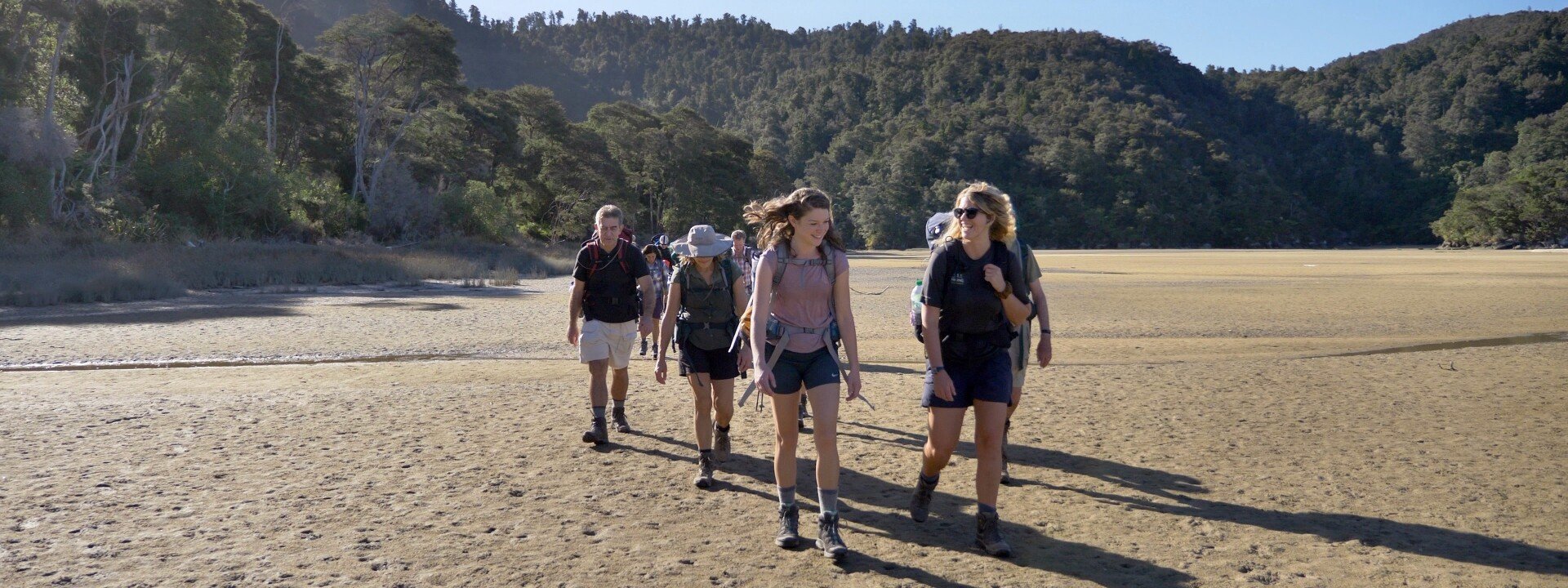
We plan our trips so that they are as unobtrusive to New Zealand's nature as possible. We do this by
travelling in small groups into less busy, off the tourist trail areas, and by trying to leave no trace of
our visit.
Ka
mate Ka mate Ka ora Ka ora
I die I die
I live I live
Ka
mate Ka mate Ka ora Ka ora
I die I die
I live I live
Tenei
te Tangata puhuru huru
This is the hairy man
Nana nei i tiki mai
Who fetched the sun
Whakawhiti te ra
And caused it to shine again
A upa ...ne ka upa...ne
One upward step, another upward step
A upane kaupane whiti te ra
An upwards step, another ...the sun shines
Hi!
"New Zealand nature - to be protected and enjoyed!"